



Let’s face it: the traditional way of building a business — where everything happens internally, under one roof — is rapidly becoming obsolete.
Once upon a time, in-house teams made sense because:
- talent was locally abundant
- communication channels were limited
- remote technology was primitive
- economic growth was predictable
But that world dissolved long ago.
Today, companies are operating globally, competing internationally, and innovating faster than ever. Customer expectations have shot up. Technology is evolving at light speed. And guess what? The old way of doing things can’t keep up.
In its place? A new model is emerging — a borderless workforce powered by outsourcing, remote collaboration, and hybrid teams that span cultures, time zones, and specialties.
This isn’t a temporary trend. It’s a structural shift in how work is done — and the businesses that embrace it will pull ahead.
Let’s explore how and why.
Why the In-House-Only Era Is Over
For decades, business leaders equated in-house teams with:
- quality control
- cultural cohesion
- security
- identity
And while those advantages still matter, they no longer justify the major trade-offs.
1. In-House Hiring Is Slowing Growth
Globally, companies are experiencing:
- longer hiring cycles
- higher recruitment costs
- widening talent gaps
- steep salary demands
- high attrition rates
This creates an internal bottleneck.
A business can have massive demand — but if they can’t hire locally to meet it, that demand becomes a limit instead of an opportunity.
2. The World Is Becoming Borderless — Work Should Too
Companies aren’t local anymore:
- global customer bases
- multi-regional compliance
- online marketplaces
- 24/7 operations
This reality doesn’t fit a purely in-house workforce that lives in a single country or region.
3. Remote Technology Makes Distance Irrelevant
Cloud collaboration tools, virtual conferencing, asynchronous workflows, distributed project management — these tools aren’t “nice-to-have.” They’re the backbone of the modern workforce.
People can now work together seamlessly from Manila to Madrid to Minneapolis — without losing productivity or alignment.
Recent News Shows Outsourcing Trust Is Growing — Not Shrinking
Modern outsourcing isn’t about cheap labor anymore. It’s about trusted partnerships and specialized capabilities.
Example — Governments Outsourcing Critical Services Worldwide
A great recent example is how governments are expanding visa outsourcing contracts for complex, high-security public services.
Visa processing was once considered a core government function — too sensitive, too important to trust outsiders.
Yet countries like Cyprus and Slovakia are now partnering with global service providers to deliver visa processing, customer support, and compliance services internationally. These contracts involve handling citizen data, multi-jurisdictional rules, and security protocols — the kind of work that used to be locked inside official walls.
When publicly accountable institutions outsource work like this, it’s a signal: external partners are now trusted with mission-critical tasks.
And that confidence is crossing over into the private sector.
Outsourcing Isn’t ‘Support Work’ — It’s a Strategic Capability
The earliest waves of outsourcing were focused on:
- call centres
- data entry
- basic admin tasks
But recent trends show outsourcing growing into high-value, core business functions — including tech, finance, compliance, and innovation.
Here’s how:
1. Specialized Skills Are Moving Offshore
Global organizations increasingly rely on external experts for:
- cloud computing
- software development
- cybersecurity
- AI integration
- digital transformation
- analytics and data science
These are functions once kept in-house because of perceived complexity — yet now they’re being outsourced not just for cost efficiency but for capability.
2. Outsourcing Supports Growth, Not Just Maintenance
When companies build offshore teams for:
- customer service
- IT support
- digital marketing
- operations
- finance and compliance
…they’re freeing internal teams to focus on strategic work like product vision, market expansion, partnerships, and customer experience design.
What Smart Leaders Are Doing Instead of In-House Overload
Leaders who succeed in the modern era aren’t just outsourcing — they’re architecting borderless teams with intent.
Their approach looks like this:
1. Identify High-Value vs. Low-Value Work
Ask:
- Does this task require unique internal knowledge?
- Would an expert outside my company do this better and faster?
- Is this work strategic or operational?
If a task doesn’t require your central internal decision-making or core IP, it’s a candidate for outsourcing.
Examples often outsourced now include:
- bookkeeping and accounting
- IT and software support
- cybersecurity monitoring
- SEO and digital marketing
- customer support
- lead generation
- specialized engineering services
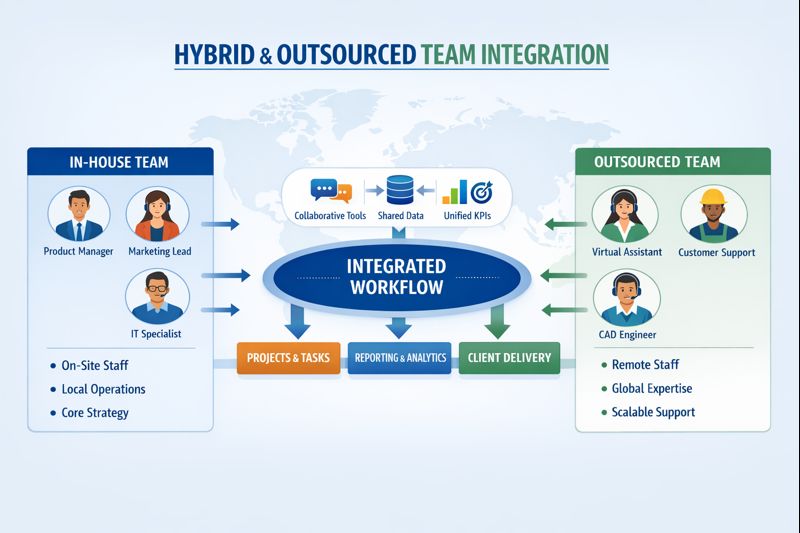
2. Use a Mix of In-House, Remote, and Outsourced Teams
The winners don’t choose one model — they combine:
- Local core teams
- External specialists
- Distributed remote teams
This hybrid approach gives companies:
✔ operational depth
✔ flexibility
✔ cost control
✔ 24/7 global support flows
✔ scalability without infrastructure drag
3. Shift Focus From “Who Does It?” to “What Outcome Matters?”
Instead of asking:
Who can do this work in-house?
Ask:
What outcome do we need — and who can best deliver it?
This subtle shift changes the talent strategy from control-centric to performance-centric.
Outsourcing Confidence Is Backed by Industry Data
Forward-looking research highlights strong growth projections in outsourcing globally — especially in Asia Pacific markets where business process outsourcing (BPO) and digital services are scaling rapidly.
One forecast estimates that the Asia Pacific BPO market will expand to about $178.7 billion by 2033, driven by digital adoption, automation, and enterprise outsourcing demand.
What’s noteworthy is:
- Outsourcing demand isn’t limited to low-skill functions anymore
- Digital transformation and AI integrations are boosting outsourcing complexity
- The market is growing strategically, not just economically
This confirms that outsourcing is no longer a side project — it’s a major operational channel.
The Distributed Workforce Is a Competitive Advantage
A borderless team is not just cost-effective — it’s strategically resilient.
Here’s why:
A. Access to Global Talent, Not Just Local Talent Pools
Companies with in-house-only hiring face:
- limited candidate pools
- talent shortages
- high salary expectations
- fierce local competition
Borderless teams give access to talent with:
✔ specialized skills
✔ global experience
✔ language diversity
✔ cultural adaptability
✔ flexible cost structures
This is especially useful for roles like:
- IT
- software development
- customer support
- accounting services
- digital marketing
…plus many others.
B. Increased Productivity Without Bigger Overhead
Remote and outsourced team members don’t require:
- physical office space
- local tax compliance
- commuter schedules
- on-site equipment provisioning
This translates to:
- lower operational cost
- higher output per dollar spent
- faster scaling of team capacity
A Real World Mindset Shift: From “Team Inside the Office” to “Team Around the World”
Traditionally, leadership defined teams this way:
My team lives here, works here, reports to me locally.
Now the mindset is:
My team works where the talent exists, communicates efficiently online, and contributes based on expertise — not location.
This shift changes how companies structure:
- workflows
- communication processes
- culture
- performance management
- incentives
- team integration
And it’s not accidental — it’s driven by positive results.
Common Questions About Borderless Teams — Answered
Q: Won’t this lead to inconsistent quality?
A: Not if you choose partners with strong vetting, performance standards, and communication protocols. Modern outsourcing firms use structured A-level screening, training, and ongoing performance management.
Q: How do I integrate outsourced teams with in-house teams?
A: Through clear documentation, shared goals, collaborative tools (Slack, Teams, Notion, Asana), and performance KPIs that align both groups.
Q: What functions should never be outsourced?
A: Strategic vision, executive decision-making, core intellectual property, and company mission are typically kept in-house — but even execution around them can be supplemented through borderless talent.
The Companies Winning With Borderless Teams
The most successful global brands — whether startups or enterprises — use outsourcing strategically, for roles including:
- IT support
- lead generation
- legal
- HR
- payroll
- healthcare
- real estate
These companies aren’t dividing their teams by location — they’re integrating their work across locations with intention, systems, and purpose.
What You Can Do Next — Strategically, Not Haphazardly
If you’re thinking about evolving your team structure, here’s a simple roadmap:
- Audit Your Workload
Identify the tasks your internal team should retain and those you should free them from. - Define Quality + Outcome Expectations
Clarify what successful performance looks like — not who does it. - Assess Talent Needs by Skill, Not Location
Build a capability map rather than a location map. - Explore Trusted Outsourcing Partners
Partners with structured talent pools, secure systems, and performance processes. - Integrate Teams Through Shared Tech and Clear Leadership
Use collaborative tools and transparent goals. - Scale Iteratively
Start with one or two key functions — learn, measure, refine.
This approach helps you embrace the borderless model without chaos, and align growth with strategic capacity — not just more hours.
The Winners Don’t Stay In-House.
They Stay Ahead.
The era of doing everything yourself or in-house is no longer the path to growth or resilience.
Today’s winners are building borderless teams that:
✔ leverage global expertise
✔ distribute risk
✔ accelerate execution
✔ optimize costs
✔ improve customer experience
✔ scale faster than competitors
Whether you’re just starting your outsourcing journey or expanding to more sophisticated functions, the organizations that thrive are the ones who think beyond borders — not just across cubicles.
If you’d like help defining which parts of your business make sense to transition to a borderless model — and how to do it without losing coordination, quality, or control — you can explore strategic discussions with partners like Remote Philippines who specialize in building distributed capabilities.
Book a call: https: https://cal.com/remotephilippines.com/30min